

Glass Fiber Reinforced Concrete vs. Cast Stone: What to Know
If you’ve been comparing cast stone mantels, you’ve probably noticed nobody tells you how they’re built. The listings describe the look, the color range, and the sizes. They rarely say what’s inside.
Here’s the part that matters: “cast stone” describes an appearance, not a method. Most cast stone mantels sold today, including every one we make, are glass fiber reinforced concrete. That’s a genuinely different material from the solid, steel-reinforced cast stone people picture, and it changes what the piece weighs and what your wall has to do about it.
What Glass Fiber Reinforced Concrete Actually Is
Our FAQ puts it plainly: “Our Products are made of GFRC (Glass Fiber Reinforced Concrete).” The mix is fine aggregate, cement, water, polymer, chemical admixtures, and glass fiber.
The fiber is the whole point. As we describe it, “the fibers take the place of steel in a wet-cast mix.” Reinforcement runs through every part of the material instead of sitting in bars at the center, so the piece doesn’t need bulk around steel to protect it.
That’s what lets it be cast thin. Our filler panels are three-quarters of an inch thick, which is not a dimension you can hit with a steel-reinforced pour.
One historical note, since builders ask: early glass fiber concrete degraded because ordinary glass reacts with the alkalis in cement. Alkali-resistant formulations solved that decades ago, which is why the material moved from experimental to standard in architectural cladding.
That history is also why the material showed up here at all. Our founder got interested in GFRC well before it was common in residential work, which is the reason this company casts the way it does rather than the way most mantel shops started. There’s more of that story on our about page.
Why “Cast Stone” Doesn’t Tell You How It’s Built
Traditional cast stone is architectural precast made to simulate cut stone: aggregate, cement, and pigment in a mold, cast solid, with steel reinforcement in larger units. It has real mass. It sits on a wall like masonry because it is masonry.
We use the phrase “cast stone” for our work because it describes what the finished piece looks like, and because it’s the language customers use. The material underneath is GFRC. Our product pages call it “lightweight cast stone,” which is the honest version of both facts in one phrase.
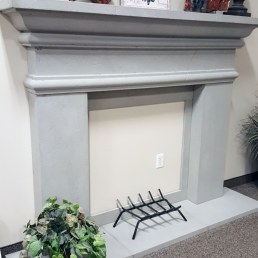
You can see the range that spans our mantel collection: over forty designs, varying from plain to heavily carved, all of them glass fiber reinforced concrete under the finish.
Neither term is wrong. They’re answering different questions, and the confusion only matters when weight enters the conversation. If you want the appearance comparison instead, we covered the difference between cast stone and natural stone separately.
Where the Two Methods Differ
Weight and the Wall Behind It
This is the practical difference, and everything else follows. Casting in thinner sections makes a piece, in our own published figure, “as much as 75% lighter than similar pieces cast with traditional concrete.”
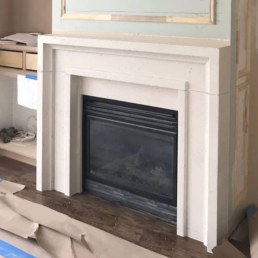
The consequence shows up on the product page rather than the spec sheet: you don’t need special wall and floor reinforcement. No blocking added to the framing, no engineered support, no crew of four. That’s the difference between a mantel you can install into an existing wall and one that needs the wall rebuilt first.
Reinforcement and Corrosion
Steel rusts if water reaches it, and rusting steel expands and spalls the concrete around it. That’s the long-term failure mode for steel-reinforced units in wet exposure.
The fibers don’t corrode. For exterior work, façade panels, and anything seeing freeze-thaw cycling, that’s a real advantage rather than a talking point. Solid precast still performs outdoors when it’s detailed properly, with adequate cover over the steel and a maintained seal, which we went through in the advantages of precast concrete.
Depth, Edges, and How Close You Look
Solid casting has an advantage here worth naming. A deep return cast in solid material reads differently at arm’s length than a formed edge on a shell, and people stand close to a mantel.
Good mold work closes most of that gap. It doesn’t close all of it, and anyone who tells you the two are indistinguishable from six inches away is selling something.

How Each One Fails
Solid pieces chip. The chip shows the same color underneath, which is the upside of integral color, and it can usually be filled.
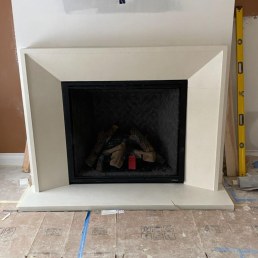
A thin shell resists chipping better, but a hard enough impact can crack it, and a cracked shell is a bigger repair than a chipped edge. Worth weighing for a precast fireplace in a high-traffic room, rather than asking which material is “stronger.”
Neither failure is common. Both are worth knowing before you put a mantel somewhere a backpack swings past it twice a day.
What This Means for Your Install
Three things change when the piece is GFRC.
The wall doesn’t need special preparation, which is the one that saves real money on a remodel. Handling gets easier, because weight is what turns a two-person job into a four-person job. And shipping costs less, since freight is priced on weight.
The savings compound at scale, too. A single mantel is one thing. A full-height feature wall or a run of contemporary panels cast solid becomes a structural conversation, while the same job in glass fiber reinforced concrete usually doesn’t.
None of that touches fire performance. GFRC is non-combustible, and our mantels allow zero clearance from combustible material, the same as a solid piece would.
When Solid Still Makes Sense
There are cases. Matching existing solid stonework in a historic building, where the join would show. Projects where a specification calls for a particular mass or thickness. Situations where an architect wants the piece to read as structural rather than applied.
Those are real, and they’re a small share of residential fireplace work. For most rooms, the honest answer is that the lighter method gets you the same look with fewer constraints, which is why we build the way we do.
It’s also not usually a decision you’ll agonize over. By the time the design is drawn and the wall is measured, one method is obviously right, and the other obviously isn’t.
Working on a spec? Tell us the wall, the span, and whether it’s inside or out, and we’ll tell you what fits. If you’re still choosing a look rather than a method, start with stone fireplace ideas by home style.
Frequently Asked Questions
A: Not quite. Cast stone describes the appearance, a concrete product made to look like cut stone. Glass fiber reinforced concrete describes the method, using fibers through the mix instead of steel bars. Our cast stone mantels are made with GFRC, which is why they’re lighter than they look.
A: Our published figure is up to 75% lighter than a similar piece cast in traditional concrete. The savings come from casting thinner sections, which the fiber reinforcement makes possible.
A: No. Special wall and floor reinforcement isn’t necessary for our mantels, which is the main practical reason the material suits remodels and upper floors.
A: Yes. The material is non-combustible, and our mantels allow zero clearance from combustible material. Fire performance is not where these two methods differ.
A: Not in normal use. The fiber reinforcement gives good impact resistance, and the material handles a household fireplace easily. The difference shows up in repair: a chip in solid material is easy to fill, while a crack in a shell is a bigger job.
Still deciding? Send us the wall and the span, and we’ll talk it through before anything gets drawn.