

Contemporary Fireplace Surrounds in Cast Stone: Clean, Not Cold
Most people meet cast stone in a traditional room. Carved corbels, a heavy shelf, dentil molding above a formal hearth. So when a homeowner tells us they want something modern, they often assume cast stone is the wrong material and go looking at steel or plaster instead.
That assumption costs them. A contemporary fireplace surround in cast stone can be as spare as anything you’d sketch on a napkin, because we cast the material in a mold we build to your drawing. The traditional look comes from the mold, not from the stone. Change the mold, and you change the character of the whole piece.
Below is what actually makes a fireplace read as modern, the three design directions we build most often, and why cast stone gets you there without the coldness that modern rooms often get accused of.
What Makes a Fireplace Surround Feel Modern
Modern fireplace design comes down to three decisions, and none of them are about material.
Proportion
Traditional surrounds are vertical and framed: a mantel shelf sitting on legs, clearly separate from the wall. Modern surrounds run horizontally, wider than they are tall, sometimes with no legs at all. A floating shelf or a single flat band across the firebox reads contemporary right away.
Edge Treatment
Every profile, bevel, and return catches light and throws a shadow line. Traditional work uses a lot of them. Modern work uses one or two, cut clean. A square edge with a small chamfer does more for a contemporary room than any color decision you’ll make.
Wall Alignment
Traditional mantels sit on the wall like furniture. Modern surrounds sit flush, recess into the wall, or set into a larger stone field so the fireplace reads as architecture instead of an object hung up there.
Why Cast Stone Handles Modern Well
Cast stone is a manufactured material. We mix aggregate, cement, and mineral pigment, then cast it in a mold. That production method is exactly why it suits contemporary shapes that natural stone struggles with. If you want the full breakdown of how the two materials differ, we covered it in the difference between cast stone and natural stone.
A slab of quarried limestone has to come down from a block, which limits how long, thin, or continuous a single piece can be. It builds up to the shape you want instead. A twelve-foot floating shelf with no visible seam is a mold problem, not a quarry problem.
Finish matters as much as shape. The material takes a smooth, honed surface that stays flat and even under downlighting, which is the finish most modern rooms are after. It also carries color through the whole body rather than on the surface, so a soft grey or a warm white holds consistent across a large field.
And it stays warm to the eye. People underestimate this part. Steel and blackened metal look sharp in photographs and hard in person, and concrete panels can drift grey and institutional.
There is aggregate in cast stone, and it gives the surface a small variation that reads as depth rather than as pattern. A cast stone fireplace gives you the clean line without the room feeling like a hotel lobby.
Three Contemporary Fireplace Surround Directions
Most stone fireplace designs that read modern land in one of three places. They differ mainly in how much wall they take and how much they ask of the room around them.
Minimalist: The Single Band
One continuous piece of cast stone around the firebox opening. Four to eight inches wide, square edges, no shelf, nothing above it but wall. It’s the most restrained option and the hardest to execute, because with no ornament to hide behind, the proportions and the joints have to be exact.
Best in a tall room with plaster or limewash walls and very little trim competing for attention.
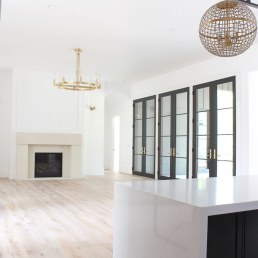
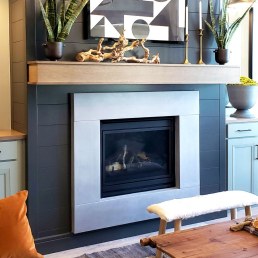
Transitional: The Floating Shelf
A simple rectangular shelf with a chamfered edge, mounted with no visible support, over a plain stone or tile field. We get asked for this one more than either of the others, and for a good reason: it gives you somewhere to set things, which pure minimalism doesn’t, and it still reads clean.
Works in open-plan living rooms and in older houses being updated rather than gutted.
Architectural: The Full Stone Field
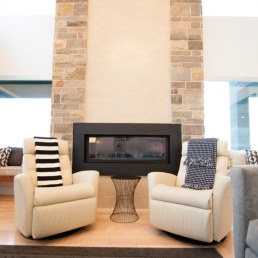
Panels of cast stone running floor to ceiling or wall to wall, with the firebox set into them. The fireplace stops being a feature and becomes the wall. Cost is where cast stone pulls ahead here, because covering a large field in natural stone gets expensive quickly and the seams are harder to control.
This one needs the room to justify it: a great room, a double-height space, or new construction where the wall gets planned around the stone.
Where We Are Seeing Modern Designs Land
Regional taste is real, and the modern requests we get cluster in a few markets. Scottsdale and Las Vegas, where desert contemporary has been the dominant new-build style for a decade. Denver and Colorado Springs, where mountain modern has largely displaced the heavy lodge look.
Those markets want different things inside the same category. Southwest modern runs toward warm whites, wide horizontal bands, and pieces that integrate with plaster walls. Mountain modern runs cooler and greyer, and usually pairs a cast stone fireplace with wood ceilings and black window frames. Plenty of these projects run outdoors as well, where cast stone surrounds follow their own design rules.
Both are contemporary. Both are cast stone. The mold and the color do the work.
What “Custom” Means When the Design Is Simple
On a traditional mantel, custom work usually means ornament: a specific corbel profile, a carved center panel, a particular molding. On a contemporary fireplace surround, custom means dimensions.
Modern designs live or die on fit. A band an inch too narrow for the firebox opening looks like a mistake, in a way that a traditional mantel’s proportions can absorb. A shelf that doesn’t align with a window head or a ceiling beam will bother you every day you walk past it. So the custom part is mostly measurement: your opening, your wall, your ceiling height, your sightlines from the kitchen.
That measuring is the work we do before anything gets cast. Send us the wall. Dimensions, photos, and any drawings you have. We’ll tell you what proportions the space wants before you commit to a design.
You can also browse our contemporary mantels and panels to see finished pieces, or look through our stone colors if you already know the shape you want.
Ready to design one? Talk to our team and send your measurements. We’ll work from your wall, not from a catalog.
Frequently Asked Questions
A: It gets its style from the mold it is poured into, not from the material. A square-edged floating shelf and a carved Victorian mantel are the same cast stone with different tooling. The traditional association comes from what’s been popular, not from any limit in the material itself.
A: A mantel usually means the shelf and any legs holding it up. A surround is the full assembly framing the firebox opening, which may or may not include a shelf. Most contemporary designs are surrounds without a mantel shelf.
A: Both work, and we make both. Concrete panels give you a flatter, more uniform grey and a distinctly industrial read. Cast stone carries aggregate and pigment through the body, so it shows more variation and more warmth. Concrete suits strictly minimal rooms; cast stone suits rooms that want clean lines but not hard ones.
A: Usually, yes. Most modern surrounds are lighter and simpler than whatever they replace, and we can size cast stone to cover the footprint of an old mantel. The real constraints are your firebox opening dimensions and your clearance requirements, and we check both before we design anything.
A: Design and approval typically run two to three weeks, depending on how many revisions you want. Fabrication follows that. Simple contemporary shapes often move faster than ornamental work, because there’s less mold detail to build.
See what is possible. Browse our contemporary mantels and panels, or send us your measurements, and we’ll sketch a contemporary fireplace surround that fits your wall.