

Cast Stone Fireplace Surrounds for Outdoor Living Spaces: Design Ideas That Work
An outdoor fireplace changes how you use your backyard. It extends the season, anchors a patio, and gives a gathering space a focal point that a fire pit alone cannot provide. But the firebox itself is only part of the picture. The surround, which includes the legs, header, and hearth that frame the firebox, determines whether an outdoor fireplace looks like a finished architectural feature or an afterthought. Cast stone fireplace surrounds are one of the best options available for outdoor applications, and the design possibilities are wider than most homeowners expect.
This guide covers the outdoor-specific design styles that work best in Western and Southwestern landscapes, what makes cast stone perform well outdoors, and how to plan your project before reaching out to a fabricator.
Why the Fireplace Surround Matters More Than the Mantel Outdoors
In an interior fireplace, the mantel shelf gets a lot of attention. It is the display surface, the visual anchor above the firebox. Outdoors, the fireplace surround takes center stage. There is no wall art, no bookshelf, no room to frame the fire. The surround is the design statement.
A well-proportioned outdoor fireplace surround defines the entire structure. It sets the style, communicates the quality of the build, and determines how the fireplace reads from across the patio. A surround that is too small makes a large firebox look unfinished. A surround with the wrong profile can clash with the architectural style of the home or the landscape around it.
Cast stone fireplace surrounds are particularly well-suited to outdoor settings because the material is non-combustible, weather-resistant, and available in a wide range of profiles and finishes that can be matched to almost any outdoor aesthetic.
Design Styles That Work in Outdoor Settings
Rustic and Natural-Finish Surrounds for Western Landscapes
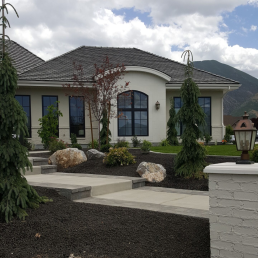
In Utah, Colorado, New Mexico, and Wyoming, outdoor living spaces often need to feel connected to the landscape: warm, textured, and grounded. Rustic cast stone surrounds with a rough-hewn or natural stone texture fit naturally into these environments. Think warm limestone tones, weathered-edge profiles, and heavy proportions that can hold their own against a mountain backdrop or wide desert horizon.
These surrounds pair well with stacked stone or natural stone veneer on the firebox body, creating a cohesive outdoor fireplace structure that looks like it belongs on the property rather than was installed on it.
Clean-Lined Modern Surrounds for Patio and Pool Settings
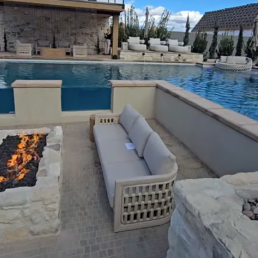
Contemporary outdoor spaces, including patio dining areas, pool decks, and outdoor kitchens, often call for a cleaner look. Low-profile surrounds with flat headers, minimal leg ornamentation, and smooth or lightly honed finishes work well in these settings. Neutral gray or white tones complement modern outdoor furniture and do not compete with the surrounding materials.
This style is especially common in Scottsdale, Las Vegas, Henderson, and Denver’s newer residential builds, where outdoor living spaces are designed as true extensions of the interior, and the aesthetic needs to match.
Mediterranean and Southwest Surrounds for Desert Climates
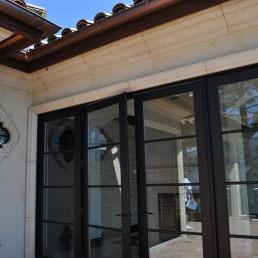
The desert Southwest has its own outdoor fireplace tradition: warm tones, arched openings, and profiles that reference Spanish Colonial and Pueblo Revival architecture. Cast stone surrounds can be fabricated with arched headers, corbelled legs, and warm travertine or sandstone-toned finishes that feel native to desert landscapes in Nevada, Arizona, New Mexico, and Southern Utah.
If the home has any Mediterranean or Southwest architectural detail, extending that language to the outdoor fireplace surround creates a cohesive property rather than a collection of disconnected elements.
Traditional Surrounds for Covered Porches and Outdoor Rooms
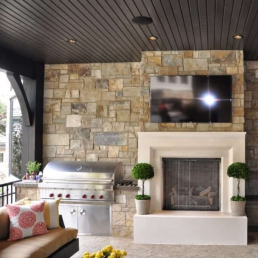
Covered outdoor spaces, such as screened porches, outdoor living rooms, and roofed patios, often support more traditional mantel profiles. A classic surround with detailed legs and a generous mantel shelf works well in these settings because the space functions more like an interior room. This style is more common in markets with traditional residential architecture, including parts of North Carolina, Georgia, and Florida, where Stone Mountain ships.
Why Cast Stone Performs Outdoors
Not every mantel material is built for outdoor use. Wood mantels deteriorate, warp, and pose a fire risk outdoors. Natural stone works but is significantly heavier and more expensive. Cast stone sits in a strong middle position.
Heat Resistance
Cast stone is non-combustible and handles the thermal cycling of an active outdoor fireplace, meaning repeated heating and cooling, without cracking or degrading.
UV Stability
Pigments in cast stone are integral to the material, not surface-applied. Color does not fade or peel with sun exposure, the way painted or coated surfaces do.
Freeze-Thaw Performance
In climates with cold winters, including Colorado, Utah, Wyoming, and Idaho, a fireplace surround is exposed to repeated freeze-thaw cycles. Cast stone, like quality concrete, is engineered to handle this. It does not absorb enough water to crack from frost expansion when properly fabricated.
Low Maintenance
Cast stone outdoors requires very little upkeep. An occasional rinse and, if needed, a sealer application every few years is generally all that is required.
Weight Advantage Over Natural Stone
Cast stone is substantially lighter than solid natural stone, which matters for outdoor installations where the supporting structure may not be engineered for heavy masonry loads.
Planning Your Outdoor Surround: Sizing, Clearance, and Code Basics
Outdoor fireplaces are subject to local building codes, and requirements vary by municipality and state. Before finalizing any surround design, confirm the following with your contractor or local building department.
How to Get Started with Stone Mountain
Stone Mountain Castings & Design fabricates custom cast stone fireplace surrounds for outdoor applications in standard and fully custom sizing. Our team can work from your firebox dimensions and design preferences to create a surround that fits your project precisely.
If you are still in the inspiration phase, our outdoor fireplace gallery is a good starting point for exploring profiles, finishes, and proportions that have worked well in real projects.
The best starting point is a measurement of your firebox opening and a sense of the aesthetic direction: rustic, contemporary, Southwest, or traditional. From there, we can walk you through the profile and finish options and provide a quote.
Ready to start your outdoor fireplace project? Contact our design team to discuss your fireplace surround or request a custom quote.
Frequently Asked Questions
A: Yes. Cast stone is non-combustible and handles the heat output of wood-burning fireplaces without issue. It is one of the better material choices for wood-burning applications, specifically because it will not ignite or degrade from heat exposure.
A: Well-fabricated cast stone is engineered to handle freeze-thaw cycles without cracking. It does not absorb significant amounts of water, which is the primary cause of frost damage in masonry. In mountain climates, cast stone outdoor surrounds perform well long-term with minimal maintenance.
A: A surround includes the full frame around the firebox, including the legs (pilasters), the header across the top, and often the hearth at the base. A mantel typically refers to the shelf above the firebox. Outdoor fireplaces often do not include a traditional mantel shelf but do use a full surround to frame the firebox architecturally.
A: Lead times vary based on order complexity and current production schedules. Standard sizing typically ships faster than fully custom pieces. Contact Stone Mountain directly for current lead time estimates before scheduling your installation.
A: Yes. Stone Mountain ships nationwide. Outdoor surround projects have been completed across the Western US, including Colorado, Nevada, New Mexico, Arizona, Idaho, and Wyoming, as well as markets in the Southeast and Mid-Atlantic.