

Cast Stone Mantels vs. Wood: What the Clearance Rules Change
A wood mantel and a cast stone mantel can look nearly identical once they’re on the wall. What separates them is a rule about how close they’re allowed to get to the fire.
Combustible mantels have to be held back from the firebox opening. How far back depends on the appliance and the local code, and the number comes from the fireplace manufacturer rather than from the mantel. Cast stone mantels carry no such setback, because there’s nothing in them to burn.
That one difference shapes more than safety. It decides how low a shelf can sit, how the facing meets the opening, and what the mantel ends up costing you to own.
Mantel Material Is a Clearance Question First
Most people choose a mantel by looking at it. Shape, then color, then price, and material somewhere near the end if it comes up at all.
Material decides what’s possible before any of that. A combustible mantel brings a required setback with it, and no amount of wanting changes the number.
You can want the shelf eight inches above the opening. If the appliance spec says twelve, the spec wins. Every time.
This tends to surface halfway through a renovation, after the design is drawn and the budget is set. Worth knowing at the start, alongside how long cast stone fireplace mantels last, since both questions usually get asked too late to be useful.
Where Wood and MDF Mantels Run Into Trouble
Solid wood is the honest version of the problem. It burns, everybody knows it burns, and the setback exists to keep it far enough from the opening that it doesn’t.
MDF and painted composites are the version people miss. They read as millwork, and they’re priced like millwork, but they handle sustained heat worse than solid wood does. The failure is rarely dramatic, and it usually turns up as a shelf that has bowed slightly or a seam that has opened along the top edge, months after anyone was still paying attention to it.
Builders meet this before homeowners do. On a spec home, the mantel gets picked late, often out of a millwork catalog, and the clearance gets discovered by whoever is standing in front of the firebox with a tape measure. Changing material at that point means changing the drawing. Late drawing changes are the expensive kind.
Neither material is dangerous when it’s installed to spec. The trouble is that the spec is a constraint you inherit, and most buyers inherit it without being told it’s there. A mantel quietly deforming above a firebox is one of the signs a mantel needs replacing, and it’s the one that’s easiest to avoid by choosing differently on day one.
What Cast Stone Mantels Are Made Of
Ours are GFRC: fine aggregate, cement, water, polymer, chemical admixtures, and glass fiber. The glass fiber does the job steel bar does in ordinary reinforced concrete, a method difference we gave its own post in glass fiber reinforced concrete versus cast stone.
For the safety question, one line from our own spec covers it. The product is non-combustible; it will not burn, and it’s compatible with all extinguishing media.
A non-combustible mantel isn’t a safety upgrade you pay extra for. It’s a different category of object, and the rules treat it as one.
That isn’t a marketing claim so much as a property of the material, and it’s why our mantels allow zero clearance from combustible material. No space is required between the firebox and the stone or the surround facing. The same reasoning runs through the advantages of precast concrete more generally.
What Zero Clearance Changes About the Design
Safety is why the rule exists. Design is where you feel it, and it’s where most of our custom mantel work begins.
The Shelf Can Sit Lower
A combustible shelf has to clear the opening by whatever the appliance requires. Remove that requirement, and the shelf sits where the room wants it instead.
On an eight-foot ceiling, this is often the whole difference between a mantel that looks settled and one that looks stranded halfway up the wall.
The test is easy. Sit where you actually sit and look at the shelf line. If it reads as a band floating above the fire rather than as the top of the fireplace, a setback is usually what put it there.
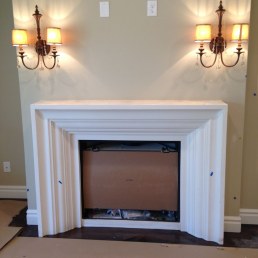
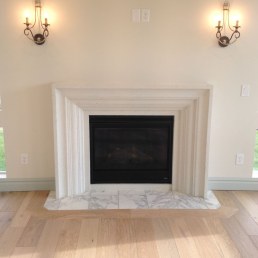
The Facing Can Meet the Firebox
Because no space is required between the firebox and the stone, the surround facing can run right to the opening. Filler panels 3/4″ thick ship with our mantels to bridge whatever gap is left, and they can be cut during installation to fit the space.
What you get is a continuous face. No band of something else holding the mantel off the fire, which is the detail that gives a lot of combustible installs away.
The Proportions Can Follow the Room
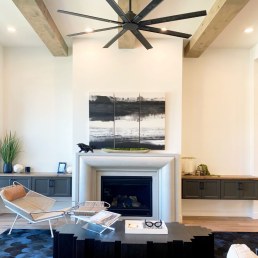
Once a setback stops dictating height, the vertical becomes a design decision again. Overmantel designs make sense in that world, because the space above the shelf is available rather than spoken for.
Special wall and floor reinforcement isn’t necessary for our mantels either, so going taller doesn’t turn into rebuilding the wall behind it.
The Cost Picture, Honestly
A wood or MDF mantel usually costs less up front. That’s true; it’s the main reason people choose one, and pretending otherwise in a post written by a company that sells the alternative would mean nothing to you.
The lower number buys a mantel with a constraint attached. You’re accepting the setback, and you’re accepting a material working near heat it would rather be away from.
Inside the stone category, the comparison runs the other way. Our pieces are as much as 75% lighter than the same shape cast in traditional concrete, and a mantel weighs a small fraction of what real rock of similar proportions would. That makes installation much easier and less costly than traditional solid stone, and the saving is in labor rather than in the piece.
There’s a second line on that invoice people forget. Cast stone mantels arrive in pieces sized for two people and a dolly rather than a crew and a lift, so the saving lands in hours.
So the honest framing isn’t that cast stone is the cheap option. It’s that the gap narrows once installation sits inside the number, and what the gap buys is a wall you never have to design around. That is the whole case for cast stone mantels against wood, and it’s narrower than a sales pitch would make it. Our stock mantel collection is the place to see the range.
Frequently Asked Questions
A: No. Ours allow zero clearance from combustible material, which means no space is required between the firebox and the stone or the surround facing. Filler panels 3/4″ thick bridge any gap and can be cut during installation.
A: Not when they’re installed at the clearance the fireplace manufacturer specifies. The risk comes from setting one closer than the spec allows, or from assuming a painted composite behaves the way solid wood does near heat.
A: Fine aggregate, cement, water, polymer, chemical admixtures, and glass fiber. The glass fiber replaces the steel bars used in ordinary reinforced concrete.
A: Yes. Ours suits gas or wood fireplaces, and the material is non-combustible.
A: No. Special wall and floor reinforcement isn’t necessary, largely because of the weight. A piece can be as much as 75% lighter than the same shape in traditional concrete.
Working out what fits? Send us the opening and the wall, and we’ll talk it through before anything gets drawn.