

Cast Stone Mantel Installation: What to Expect
A cast stone mantel installation is usually easier than people brace for. The piece is lighter than it looks; it doesn’t need the wall rebuilt behind it, and the parts that bridge the gap to your firebox come in the crate.
The step that goes wrong is the one nobody warns you about, and it happens before anyone picks up a tool. It happens on a driveway, with a freight driver waiting for a signature.
Here’s the whole sequence, from what to have ready to what actually ships.
Who Handles a Cast Stone Mantel Installation
Most of our mantels go in by a general contractor, a mason, or a capable homeowner with help. There’s no specialist trade for it and no certification involved.
That surprises people who assumed stone meant stonemasons. The reason is weight, which the section below explains.
Some jobs still call for a professional. If you’re moving a gas line, swapping the firebox, or tying the piece into new tile and a new hearth, the mantel installation is the simple part of a job that isn’t simple at all. Hire for the hard part. The mantel comes along with it.
For a full renovation rather than a swap, the sequencing matters more than the installing does, and the planning errors are the expensive ones. We covered those separately in common fireplace renovation mistakes.
Before the Truck Arrives
Shipping takes 3 to 5 business days after a piece leaves our facility. The carrier calls you to set a delivery appointment, usually a 2-hour window.
Four things to have sorted before that window opens.
People. Line up two or three able-bodied helpers. Liftgate trucks aren’t always available, and an oversized crate can need forklift service or a pickup from the freight terminal instead.
Somewhere to put it. Delivery is curbside to the lower 48. The crate comes off the truck and stops there, so decide in advance where it goes and how it gets inside.
Your numbers. Measure the firebox opening, the wall width you have to work with, and the floor-to-ceiling height. Write them down before delivery day rather than during it. A fireplace surround installation goes sideways most often because somebody assumed a number instead of checking it, and ten minutes with a tape now beats any amount of improvising later.
A clear path and a flat wall. Check the wall is flat where the piece lands. Measure your opening again now rather than on installation day, and if anything looks off against what you ordered from our stock mantel collection, that’s the moment to raise it.
Taking Delivery Is the Step People Get Wrong
Read this part twice. It’s the only step in the process with a deadline attached.
You are responsible for inspecting everything before you accept the delivery. Uncrate the pieces and look at them while the driver is still there, which feels awkward and is the entire point.
If anything is damaged, write CONTENTS DAMAGED on the freight delivery receipt before you sign it. Then photograph the damage, the crating, and the marked receipt, and get in touch within 24 hours.
Without that notation on the receipt and without the photos, we can’t be held responsible for repair or replacement. That isn’t us being difficult. It’s how freight claims work, and the signature is what closes the window.
The driver will not wait forever, and that pressure is exactly why people sign first and look afterward. Decide before the truck arrives that you’re going to open it.
One more reason to look closely: mantels are made custom to each order, so there are no returns or exchanges.
What Makes a Cast Stone Mantel Easier to Install
Three properties do most of the work, and they’re the reason the trade requirement is lower than people expect.
The Weight You Don’t Have to Plan Around
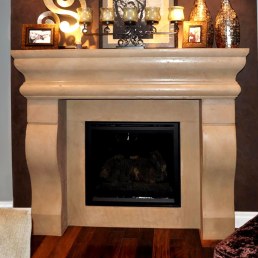
A piece can be as much as 75% lighter than the same shape cast in traditional concrete, and a mantel weighs a small fraction of what real rock of similar proportions would.
That’s why two or three people can handle what looks like a stonemason’s job. It’s also why the piece is lighter than it looks, which comes down to glass fiber replacing steel bar in the mix.

The Wall Behind It
Special wall and floor reinforcement is not necessary for our mantels. No blocking to add, no framing to open up, no floor structure to check.
For a remodel, this is usually the difference between a weekend job and a project. For an upper floor, it’s often the difference between possible and not.
It also moves when the work can happen. A mantel installation that needs no structural work can go in late, after the drywall and the paint, rather than early while the wall is still open. One fewer thing holding up the room.
The Gap to the Firebox
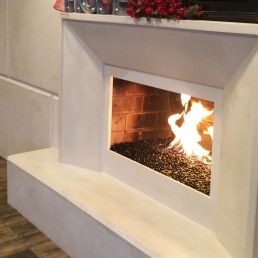
Almost no firebox opening matches a mantel exactly. Filler panels, 3/4″ thick, ship with the mantel to bridge whatever gap is left, and they can be cut during installation to fit the space.
They’re included in the price rather than sold separately. Worth knowing, because the gap is the thing people start improvising around when they don’t realize the answer was already in the crate.
What Ships With the Mantel, and What Doesn’t
In the crate: the mantel in its pieces and the filler panels.
Not in the crate: adhesive, fasteners, shims, and the tools. Your installer brings those, and we’d rather they use what they trust than what we guessed at.
A mantel installation has one genuinely fiddly moment, and it’s the filler panels. They get cut to fit, which means cutting once the piece is standing and the real gap is visible rather than the one on the drawing. Budget a little patience there. The rest is set, level, done.
Keep the crating until the piece is actually set. If something turns up chipped once it’s out and in good light, the crating is part of the evidence.
For the sequence itself, we have an installation video that walks through it. Watch it before the delivery rather than after, since a few of the decisions are easier to make before the piece is standing in the room.
Having something made rather than ordering stock changes nothing here. The custom mantel work follows the same install process. Custom changes the mold, not the method.
Frequently Asked Questions
A: Not necessarily. A general contractor, a mason, or a confident homeowner with two or three helpers can do it. There’s no specialist trade or certification required.
A: Two to three for the delivery and the handling. That’s also what we recommend having on hand for unloading, since a liftgate truck isn’t guaranteed.
A: No. Special wall and floor reinforcement isn’t necessary, which is the main reason these work well in remodels and on upper floors.
A: Write CONTENTS DAMAGED on the freight receipt before signing, photograph the damage, the crating, and the receipt, and contact us within 24 hours. Without the notation and the photos, we can’t cover repair or replacement.
A: No. They’re included with the mantel price, 3/4″ thick, and can be cut during installation to bridge the gap to your insert.
Measuring up? Send us the opening and the wall, and we’ll walk you through it before anything is cast.