

Stone Fireplace Mantels and Clearance: What the Rules Actually Say
Most people pick a mantel and then find out what they’re allowed to do with it. That’s the wrong order, and it’s why clearance ends up being the thing that redraws a design late.
Clearance is the required distance between the fireplace opening and anything combustible. Wood and composite mantels have to respect it. Stone fireplace mantels don’t, because there’s nothing in them to catch.
Here’s the actual rule, where it changes, and the four numbers worth having before you order anything.
Clearance Decides Your Mantel Before You Do
A clearance requirement isn’t a suggestion about where the mantel looks best. It sets a minimum, and your design lives above that minimum, or it doesn’t get built.
What makes it awkward is the timing. People find the number after they’ve chosen a shelf height, which means the choice was never really open. Planning errors like this one are the costly kind, and we’ve written about the rest of them in common fireplace renovation mistakes.
Two things decide your number: what kind of fireplace you have, and what the mantel is made of. The sections below take them in that order.
Worth saying up front that the whole question only applies to combustible mantels. The exemption that stone fireplace mantels carry is a large part of why people end up choosing one.
The Rule for a Masonry Fireplace
For a traditional masonry fireplace, clearance comes from your local building code. Codes are adopted jurisdiction by jurisdiction and amended locally, so there’s no single national number, and a blog post is the wrong place to go looking for one.
What stays consistent is the shape of the rule. Combustible material is restricted in bands measured out from the fireplace opening, on the sides as well as the top, and the restriction eases the further out you go. We took up what that setback does to a design separately, which is a different question from what it requires.
None of it governs stone fireplace mantels. If that’s the direction you’re already heading, read this section as background rather than as a constraint on your design.
Closest to the opening, nothing combustible. There’s a zone right around the firebox where wood, composite, and painted millwork aren’t permitted at all. This is the band people lose, because a shelf that wanted to sit tight above the firebox has to move, and moving it changes the proportions of the whole wall.
Through the middle band, depth is capped. Combustible material is allowed here but its projection is limited, and the depth you’re permitted grows the further you get from the opening. A chunky timber shelf is usually thicker than the middle band allows. Which is why so many wood mantels end up either further from the fire than the designer wanted, or thinner than the room wanted.
Past that, your call. Beyond the middle band, thickness stops being a code question and combustible material of any depth is permitted. That outer boundary sits further from the firebox than most people picture when they imagine a mantel.
Your building department will give you the real distances for your jurisdiction, usually over the phone in one call. Ask before the design gets drawn rather than after.
Gas, Electric, and Factory-Built Units Follow the Label
If your firebox is a manufactured unit rather than masonry, the code section above is not your answer. The manufacturer’s listed clearances govern, and they’re specific to the model.
Those listed clearances can be stricter than the code or more generous than it. There’s no way to guess which, and no general rule that covers gas versus electric as categories. The number lives in the installation manual for your particular unit.
Find that manual before you design anything. If the house came with the fireplace already in it and the paperwork is gone, the model number is usually on a plate inside the firebox opening, and manufacturers post manuals by model number.
Older units deserve extra care. A firebox installed decades ago may be sitting behind a surround that would not pass inspection today, and the listing that applies is the one for the unit itself rather than whatever happens to be around it now.
One thing doesn’t change with the unit type. A non-combustible mantel carries no setback either way, which comes down to what the material actually is rather than what it’s installed against.
What to Measure Before You Order
Three things, and ten minutes with a tape. Write them all down before you start looking, then compare them against the sizes in our stock mantel collection, because a stock piece that fits is a shorter road than a custom one that has to be drawn. They’re also the numbers to have in hand for what happens on installation day.
The Firebox Opening
Width and height of the opening itself. Measure the opening, not the metal trim around it, since the trim often stands proud by an inch or more on each side and isn’t what a mantel sizes against.
Get this one wrong and everything downstream is wrong with it.
The Wall and What Limits It
Total width you have to work with, plus whatever constrains it: a return wall, a window, built-in cabinetry. Add floor to ceiling, which governs how tall the piece can go before it starts to crowd the room.
Measure the wall at mantel height rather than down at the floor. Baseboard, a chair rail, or a wall that’s slightly out of plumb will all give you a different number low down, and the mantel doesn’t live down there.
The Hearth
Depth and height, if there’s a raised one. This is the measurement people skip, and it matters more than it looks.
A raised hearth means the mantel legs land on it rather than on the floor, which changes every other number on the list.
Why Stone Fireplace Mantels Sidestep the Question
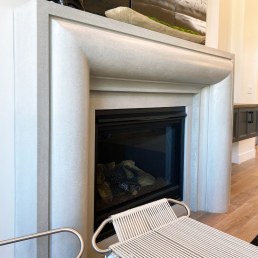
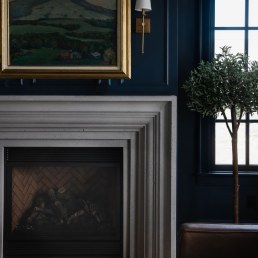
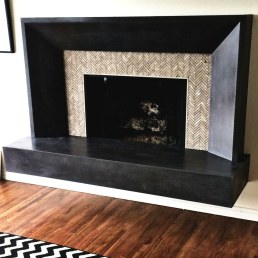
Our mantels are non-combustible. They allow zero clearance from combustible material, which means no space is required between the firebox and the stone or the surround facing.
That removes the constraint rather than working around it. The shelf sits where the room wants it. The facing runs to the opening instead of stopping short of it. Nothing in the design is being held back by a number from a manual.
There’s a practical consequence past the design one. Stone fireplace mantels take clearance out of the inspection conversation, so there’s nothing to document and no setback to defend later.
It’s also why a stone piece tends to outlast the room it was designed for, something we got into in how long a cast stone mantel lasts.
If your opening is an unusual size, or the hearth is doing something awkward, that’s what custom mantel work is for. Custom changes the dimensions, not the clearance answer, which stays zero.
Frequently Asked Questions
A: That depends on your local code, and on the manufacturer’s listed clearances if the firebox is a manufactured unit. The pattern holds even though the numbers vary: combustible material is barred closest to the opening, limited in depth through a middle band, and unrestricted past that. A non-combustible mantel has no required setback at all.
A: No. Ours are non-combustible and allow zero clearance from combustible material, so the facing can meet the firebox opening.
A: Yes. The bands are measured out from the fireplace opening in every direction, rather than only upward from the top edge.
A: Probably, and you can’t assume which way. Gas and electric units are manufactured appliances, so their listed clearances apply rather than the masonry code section, and those vary by model.
A: Your local code is the answer rather than one version of it. Jurisdictions adopt different editions of the model codes and add their own amendments, so the only distances that count are the ones your building department gives you for your address.
Not sure what your numbers allow? Send us the opening and the wall, and we’ll tell you what fits before anything is ordered.